
Your buyers are making decisions without visiting your website.
They're using AI to research, compare, and shortlist vendors — all before they ever click a link. That changes what visibility means and what content has to do.
This is zero-click search: when a buyer gets their answer directly on the search results page or in an AI response, without clicking through to a website.
The numbers confirm the shift:
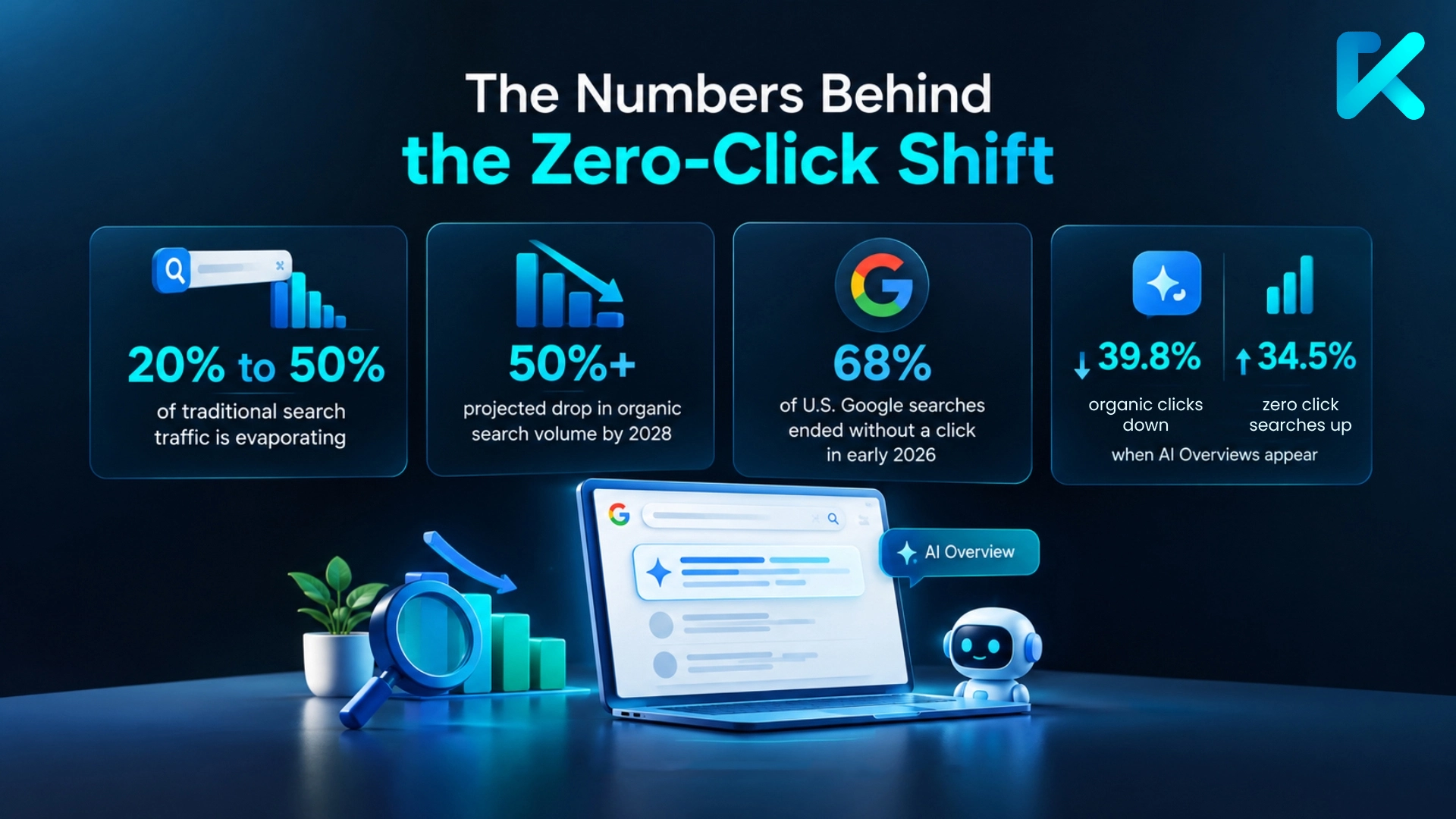
This fundamentally changes how buyers evaluate software, services, and partners. AI chatbots and zero-click interfaces now influence decisions earlier — delivering answers, comparisons, and vendor shortlists before users ever click a link.
But most industry observers miss a nuance.
The nuance: Clicks are down, but intent is up
While raw click volume is down, downstream buyer intent has increased.
B2B purchasing is risk-averse. No executive signs a high-value contract based solely on an AI-generated answer. While over 70% of AI-powered search users ask top-of-funnel questions, AI now influences every buying stage.
Buyers still visit your website but for different reasons. They come to verify credibility, assess authority, and evaluate human expertise beyond what AI can summarize. The click is no longer just discovery. It's due diligence and bottom-of-funnel validation.
That changes the strategic question from "How do we win back lost traffic?" to "When buyers stop clicking for basic answers, how do we remain the brand that gets cited, remembered, and chosen?"
That's where GEO and AEO come in.
GEO and AEO: The new visibility standard
Traditional SEO asks: "How do I rank?"
GEO asks: "How do I become the answer?"
- GEO (Generative Engine Optimization) focuses on getting cited by AI models like ChatGPT, Gemini, and Perplexity.
- AEO (Answer Engine Optimization) targets direct answers — featured snippets, People Also Ask, and AI Overviews.
Together, they help brands stay visible in a zero-click world. GEO earns the citation. AEO earns the answer box.
GEO structures content so AI models can understand, trust, and attribute it. That means clarity, structure, and authority — not keyword-stuffed copy.
Even brands you'd expect to be winning this game aren't. Industry leaders may see GEO performance lag SEO by 20–50%. The gap isn't about budget or brand size. It's a different discipline most organizations haven't built yet.
Here's how to build for it.
Three strategies for zero-click visibility
Publish natively, not as funnel bait.
Every social platform, such as LinkedIn, X, and YouTube, aims to keep users on its app longer to serve more ads. When you add a website link, the platform sees it as an exit sign. To discourage users from leaving, its algorithm may reduce the post's visibility to your followers so they stay longer on the platform.
The data shows this pattern. When Nieman Lab analyzed 18 media accounts, link-heavy accounts consistently underperformed. BBC, which includes links in its posts, had a median engagement of 71 across 15.1 million followers. Globe Eye News, which posts natively with no links, had a median engagement of 8,418 across 886,000 followers despite having 17× fewer followers.
The comparison isn't perfect: the accounts differ in content and posting frequency. But patterns across platforms and studies suggest that link posts reach fewer people. Platforms don't just deprioritize links. They reward content that keeps users engaged on the platform.
So, stop using social media just to drop links to your blog and treat social platforms as destinations, not traffic funnels. Publish complete, self-contained value natively — insights, frameworks, graphics, or key takeaways that users can absorb without leaving the feed.
If you must share a link, place it in the comments or your profile bio.
Give AI something worth citing.
Visibility is about giving search and AI systems something worth citing.
Information Gain measures how much unique value your content adds to existing information. An analysis of 150 top-ranking pages found pages with 15+ unique figures averaged an Information Gain Score of 62.1 versus 40.2 for pages with one or none.
Proprietary data, benchmarks, firsthand experience, and original research make content more valuable and more citable.
Instead of repeating industry definitions or competitor talking points, invest in information competitors and AI cannot easily reproduce: customer insights, internal data, real-world case studies, original research, and proprietary frameworks.
Give AI a reason to cite your brand and buyers a reason to remember it.
Build content that travels without a click.
"Rank first and AI will follow" doesn't hold. An analysis of 15,000 prompts found only 12% of links cited by ChatGPT, Gemini, and Copilot appeared in Google's top 10 results for the same query. AI systems retrieve differently from search engines. They expand queries, combine sources, and prioritize extractability and attribution over search ranking.
If your content can't rely on clicks, it must travel as a quote, synthesis, or cited source. That means structuring content for AI extraction:
- Lead with direct answers
- Make each section independently citable
- Support claims with original data, named sources, dates, and figures
- Use clear headings, tables, FAQs, and numbered lists
The easier your content is to extract and attribute, the more likely it is to be cited. That's how you stay in the conversation when no one clicks.
Ready to dominate zero-click discovery?
Kalpins helps B2B tech brands build GEO and AEO engines that capture AI citations and bottom-of-funnel validation. Talk to our strategy team →